
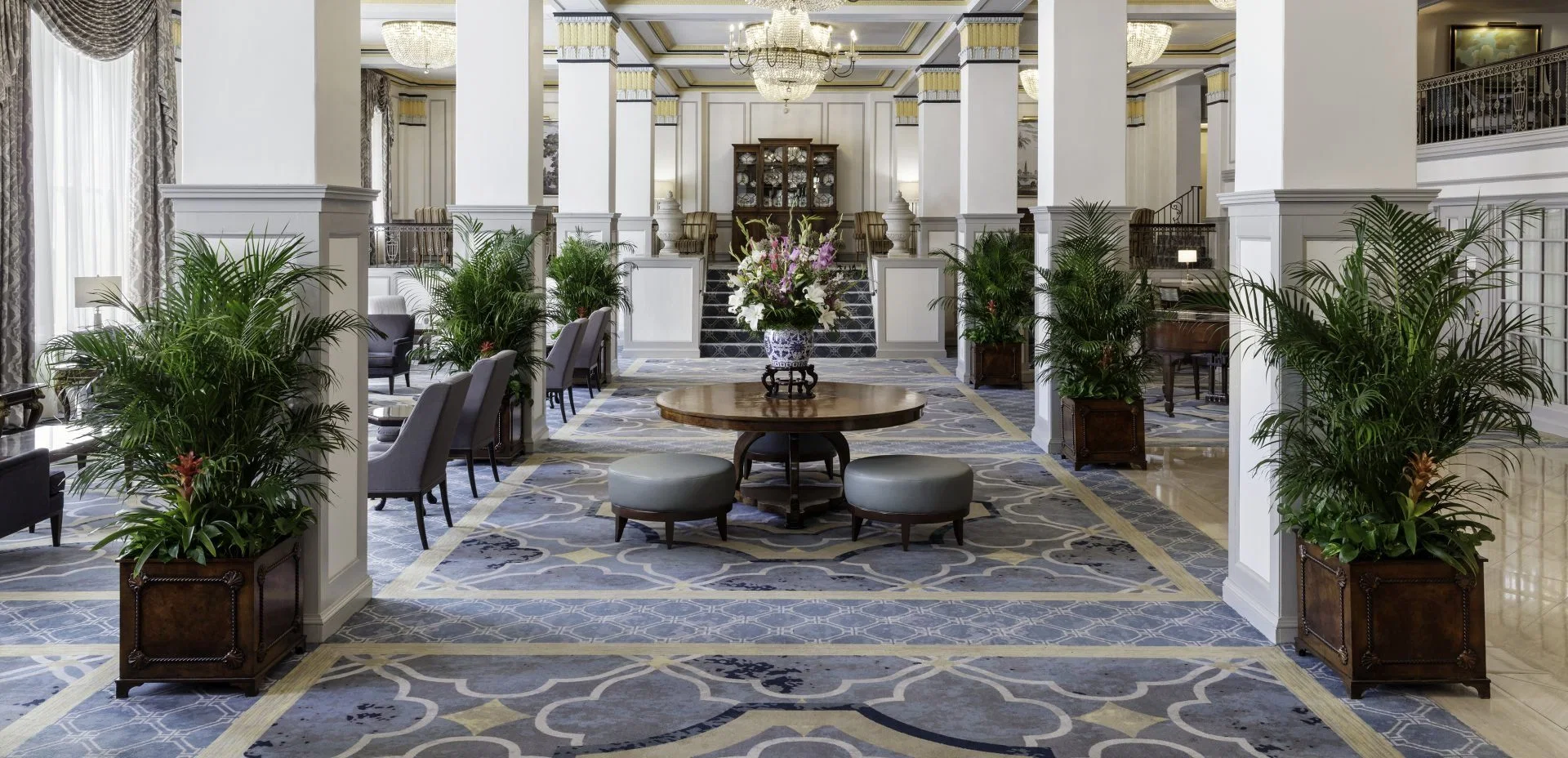
Francis Marion Hotel is one of Charleston's more meaningful historic hotel options because it changes the event strategy in concrete ways. Venue choice here is not simply aesthetic.
Current hotel footer places Francis Marion Hotel at 387 King St in Charleston.
Useful for historic-hotel conferences, ballroom meetings, gala dinners, and downtown overflow away from the larger convention campus.
For the hotel, treat the North Charleston campus as a service-order-driven venue environment where utilities, staffing, rigging, loading-dock procedure, and current decorator or catering paths should be verified against current facility instructions.
For the hotel, a venue section that does its job well lets the buyer see, the buyer can quickly see whether the building matches the commercial objective and what must be managed differently here than at another Charleston property.
Verified venue facts
What we know about Francis Marion Hotel
- Current hotel footer places Francis Marion Hotel at 387 King St in Charleston.
- The event-space details section says the Colonial Ballroom seats 200 for dinner or 250 reception style, while the Carolina Ballroom seats up to 350 for dinner or 500 reception style.
- The same section says the Gold Ballroom seats 130 for dinner or 200 reception style, and the Parkview Room overlooks Marion Square.
Working at Francis Marion Hotel
Current hotel footer places Francis Marion Hotel at 387 King St in Charleston.
The Colonial Ballroom seats 200 for dinner or 250 reception style, while the Carolina Ballroom seats up to 350 for dinner or 500 reception style.
The Gold Ballroom seats 130 for dinner or 200 reception style, and the Parkview Room overlooks Marion Square.
Located at Marion Square / Upper Peninsula Edge.
Projects at the hotel start with its published floor plan, dock schedule, and service-order deadlines. Everything downstream — build, freight, install, labor — is planned against those real inputs.
Charleston as a trade show city
For the hotel in Charleston, trade shows move fast. Major venues book out months in advance, freight windows run tight, and the exhibitors who win their weeks are the ones who arrive with a plan already in hand.
For the hotel, trade show weeks in Charleston compress decisions. Dock windows are finite, rigging slots fill fast, and the labor calendar around a citywide conference runs hot. Exhibitors who treat planning as optional lose time they do not get back.
For the hotel buyers, it has 15,000 square feet of exhibit space and is the largest convention facility in the Charleston metro, which sets the practical ceiling for a booth program working the market.
For the hotel, Kiawah and Wild Dunes both market major meeting inventory, giving Charleston a credible resort-conference layer beyond downtown and North Charleston.
Why Trade Show Services of Charleston
On the hotel, the difference from a national vendor shows up at the dock. A local team with an in-house shop can solve most install-day problems in the time it takes to drive back to the building with the right part.
Clients who run repeat programs across multiple dates pay less per event when the same team handles everything. Less re-briefing, less re-training, less re-checking. The operational overhead drops year over year.
Who handles what during the Charleston install window
On the hotel, there is no single labor model for Charleston trade shows. The right approach depends on the specific venue and the show organizer's contracts.
On the hotel, the workable version of Charleston labor planning is boring on purpose: read the manual, match the scope to its categories, order what the venue sells directly, and schedule everything else around its posted windows. Surprises almost always trace back to a step someone skipped.
For the hotel at Charleston Gaillard Center, vendors must be approved to work on property and may apply to the preferred vendor list, while the services section names Oak View Group as the in-house hospitality partner.
When this the hotel page references labor, rigging, utilities, catering, or decorator flow, the goal is to help buyers plan around verified venue behavior rather than assume last-show conditions still apply. Venue labor and service expectations vary by property, so current venue instructions should be reviewed before promising any specific outside-scope path.
Scope at Francis Marion Hotel
On the hotel, project scope usually spans design, fabrication, graphics, AV, labor coordination, freight, install, show-hours support, and strike.
On a the hotel build, the budget usually carries structure, graphics, AV, show-service orders through the venue, labor, freight, supervision days, and closeout. Items layer in or drop out based on the hotel scope.
A bad one has many, because they were not.
On the hotel, out of scope by default are show organizer fees, booth lease costs paid directly to the show, staff travel and per diems, and any custom software or data-capture tooling the client runs on its own stack. Those stay on the client side and plug into the project through coordination, not rebilling.
From first call to strike
Every the hotel engagement begins the same way. From those four inputs, a real plan can be built.
On the hotel, venue coordination comes next.
On a the hotel build, production brings the plan into physical form: fabrication, graphics, AV, rentals, and the named lead who will run the floor.
On the hotel, install days are owned by a single on-site lead. That person carries the plan, works the punch list in real time, and reports up once a day with real status.
During the hotel show hours, the booth is a live operating space. The on-site team handles repairs, sponsor requests, lead-capture issues, and any venue questions so the client's staff can focus on conversations.
On a the hotel build, closeout is tight: strike, crate, manifest, storage designation, and a written post-show report delivered within a day. That document drives the next the hotel booking.
Cost and lead time
On the hotel, pricing is driven by real line items: fabrication or rental, graphics, show services, labor, freight, and travel where it applies. Round numbers without that breakdown usually hide something.
On a the hotel build, cost scales with how it is built, how big it is, what the venue charges for its own services, how the graphics are produced, how far the crates travel, and how many days the team stays on-site.
On the hotel, lead time drives everything. Custom: 16 to 20 weeks. Rental: 8 to 12.
What a successful project looks like
A successful the hotel project in Charleston looks like a booth that lands on time, passes venue inspection on the first walk, runs without incident through show hours, and ships out the same day it strikes.
On a the hotel build, ROI is measured at the lead and pipeline level.
A week after the show, the hotel build's actual floor performance is already clearer than any pre-show projection. We document those observations alongside the technical closeout so the next cycle inherits real signal, not nostalgia.
Francis Marion Hotel planning questions
How does labor work in Charleston?
It runs venue by venue.
How much lead time is ideal?
Custom builds run best with 16 to 20 weeks of lead time. Rentals take 8 to 12 weeks.
What information kicks off a project?
The show, the venue, the booth number, the dates, and a target budget range. From those, an initial scope and a realistic cost come back within a few days.
Who runs the booth on-site?
One named show-site lead runs the install, the show hours, and the strike. That person carries the floor plan and the punch list from crates to doors and reports up once a day.
Can the booth travel to the next city on our calendar?
Same structure, swappable graphics, standard crates.
What happens if something breaks during show hours?
The on-site lead handles it.